People hear “we recovered stolen Tether” and picture a heist in reverse — a key cracked, a thief’s wallet broken into, funds yanked back out.
It’s nothing like that.
It’s almost bureaucratic.
Here’s what actually happens when USDT is recovered after a theft, explained step by step by one of our blockchain investigators.
What Is USDT, Really?
USDT isn’t just a coin sitting in a wallet. It’s a smart contract — think of it as a vending machine. Instead of taking your money and handing you a snack, it takes an instruction and moves a credit from one account to another.
Your “balance” is simply a number the machine keeps next to your address. When you send USDT, you’re not shipping an object anywhere — you’re asking the machine to subtract from one row and add to another.
That framing matters because a vending machine has an owner. And like any vending machine, its owner can do things no customer ever could.
The USDT smart contract contains special administrative functions that only Tether can invoke. Three of these functions commonly underpin the recovery process: blacklisting, burning, and reissuing (or minting) replacement tokens.
An important caveat: not every token labelled “USDT” is actually issued by Tether. Bridged versions of USDT — tokens representing USDT on blockchains other than those where Tether issues natively — generally cannot be frozen by Tether because Tether did not issue them.
These are separate tokens created by third-party bridge operators and backed by locked Tether-issued USDT as collateral. Even though users commonly refer to them as “USDT,” they are technically distinct assets, and any freeze authority (if it exists at all) belongs to the bridge operator rather than Tether.
Phase One: The Freeze
The first step in any USDT recovery is the freeze.
When Tether blacklists an address, that address becomes effectively stuck. The balance remains visible on-chain, but the contract will no longer process instructions that would move those tokens. The funds remain stranded while the legal process continues.
In practice, freezes are often initiated early in an investigation, sometimes well before any final court ruling. Law enforcement agencies — including the FBI, DOJ, or their international counterparts — secure the necessary legal authority under their local procedures and coordinate directly with Tether.
Speed matters enormously here. A delay of even a day can be the difference between successfully freezing funds and finding that they have already been moved elsewhere.
How to Verify a Freeze
Don’t rely solely on a wallet balance.
Instead, check the contract state directly. Passing an address to the USDT contract’s is Blacklisted function returns a simple true-or-false response. That result reflects the address’s status within the smart contract itself, rather than how a third-party explorer chooses to display the balance.
Phases Two and Three: Burn, Then Refund
A freeze can remain in place for a long time — weeks, months, or sometimes years.
Many frozen addresses never progress further and simply remain frozen indefinitely.
What happens next only occurs once there is an established legal basis to proceed, and Tether chooses to act on it.
Once that stage is reached, the final phases often unfold very close together.
The Burn
The next stage is the burn.
This is not a transfer and not a traditional seizure. Instead, the frozen tokens are removed from circulation through a burn operation recorded on-chain.
One practical warning: because this process uses administrative contract functionality rather than a standard wallet-to-wallet transfer, some analytics platforms may not display the resulting balance changes correctly. In certain cases, an address can appear to retain a balance even after tokens have been burned.
For verification, it is often best to cross-check multiple sources, including blockchain explorers and tools that read the underlying contract state directly.
The Refund
If the frozen USDT has been burned, where does the victim’s replacement come from?
Historically, replacement USDT has been observed coming from Tether-controlled treasury addresses rather than directly from the frozen address itself.
The precise operational mechanism may vary between blockchains and may evolve over time. What is consistently observable on-chain is that reimbursement transactions originate from addresses under Tether’s control rather than from the suspect wallet.
The Proof Is in the Decimals
Here’s the detail that makes a USDT recovery provable rather than merely claimed: the blockchain provides a transaction trail that can be verified independently.
In several recoveries our team has investigated, multiple frozen addresses associated with the same case were burned before a reimbursement transaction matching the aggregate value was issued shortly afterwards.
In those cases, the destroyed amount and the refunded amount matched to the last decimal place.
That decimal-perfect equality becomes a forensic fingerprint — visible to anyone willing to examine the blockchain records.
In recoveries our team has worked on directly, the confirming pattern was clear: multiple criminal addresses were burned within a short period, followed by a reimbursement transaction carrying the exact aggregate amount.
The transactions were separate events rather than an automatic consequence of the burn itself.
In some cases, the reimbursed funds were routed through regulated infrastructure associated with the iFinex group before ultimately being returned to the victim.
Rather than pursuing control of a suspect’s private keys, Tether’s recovery mechanism relies on freezing and, where appropriate, invalidating tokens held at addresses under its blacklist control. Replacement funds are then issued through a separate administrative process.
The blockchain records every step, and the arithmetic can be independently verified.
A USDT recovery doesn’t look like a Hollywood heist.
It looks more like an accountant making entries on a ledger — not through cinematic exploits, but through authority built directly into the smart contract itself.
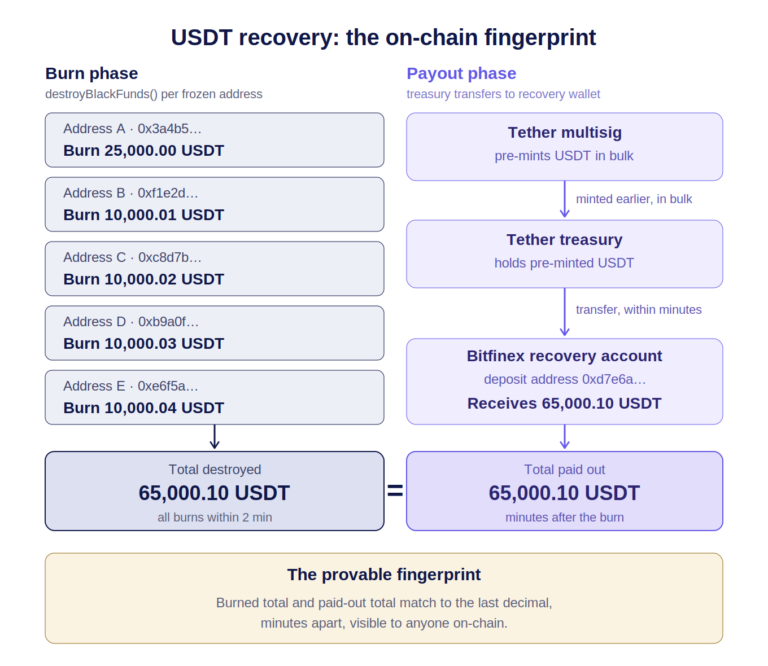
An example of a USDT recovery.
Frequently Asked Questions
Can Tether freeze USDT associated with theft or fraud?
Yes. Tether can blacklist addresses on USDT contracts that it directly controls, preventing those addresses from moving tokens. This is often the first stage of a recovery process and is typically undertaken in coordination with law enforcement once appropriate legal authority has been established.
How long does a USDT freeze take to become a full recovery?
It varies significantly.
A freeze can sometimes occur within days of a report, but any subsequent burn-and-refund process generally depends on legal proceedings and supporting evidence. This can take weeks, months, or longer. Some frozen addresses never progress beyond the freeze stage.
Can bridged or wrapped USDT be frozen?
Generally not by Tether.
Bridged versions of USDT are separate tokens issued by third-party bridge operators rather than by Tether itself. Any freeze authority typically rests with the operator of that bridge, not with Tether.
How can I verify whether a USDT address has actually been frozen?
The most reliable method is to check the contract’s is Blacklisted function directly via an appropriate blockchain explorer or contract interface.
Relying solely on a displayed wallet balance can be misleading because some analytics platforms do not always reflect administrative contract actions immediately or accurately.
Does Tether guarantee a refund once funds are frozen?
No.
A freeze prevents funds from moving, but it does not guarantee reimbursement. Any burn-and-refund process remains discretionary and depends on the legal basis supporting the claim, the available evidence, and Tether’s own decision-making process.
Working with investigators experienced in gathering evidence and coordinating with law enforcement can materially improve the prospects of a successful outcome.
Legal Disclaimer
Important: Recovery outcomes are highly fact-specific. Tether retains sole discretion regarding any freeze, burn, or reissuance action, and neither a blacklist nor a freeze guarantees reimbursement. This article describes recovery patterns that have been observed on public blockchains and should not be interpreted as legal advice or as a guarantee of any particular outcome.
Author

Guglielmo Anfossi
Guglielmo operates on high-complexity blockchain investigations, focusing on escalation cases that require deep protocol-level analysis and structural interpretation of on-chain activity beyond standard tooling. His work centres on adversarial behavior mapping and the analysis of obfuscation strategies within DeFi ecosystems, including non-linear fund flows and malicious smart contract design.