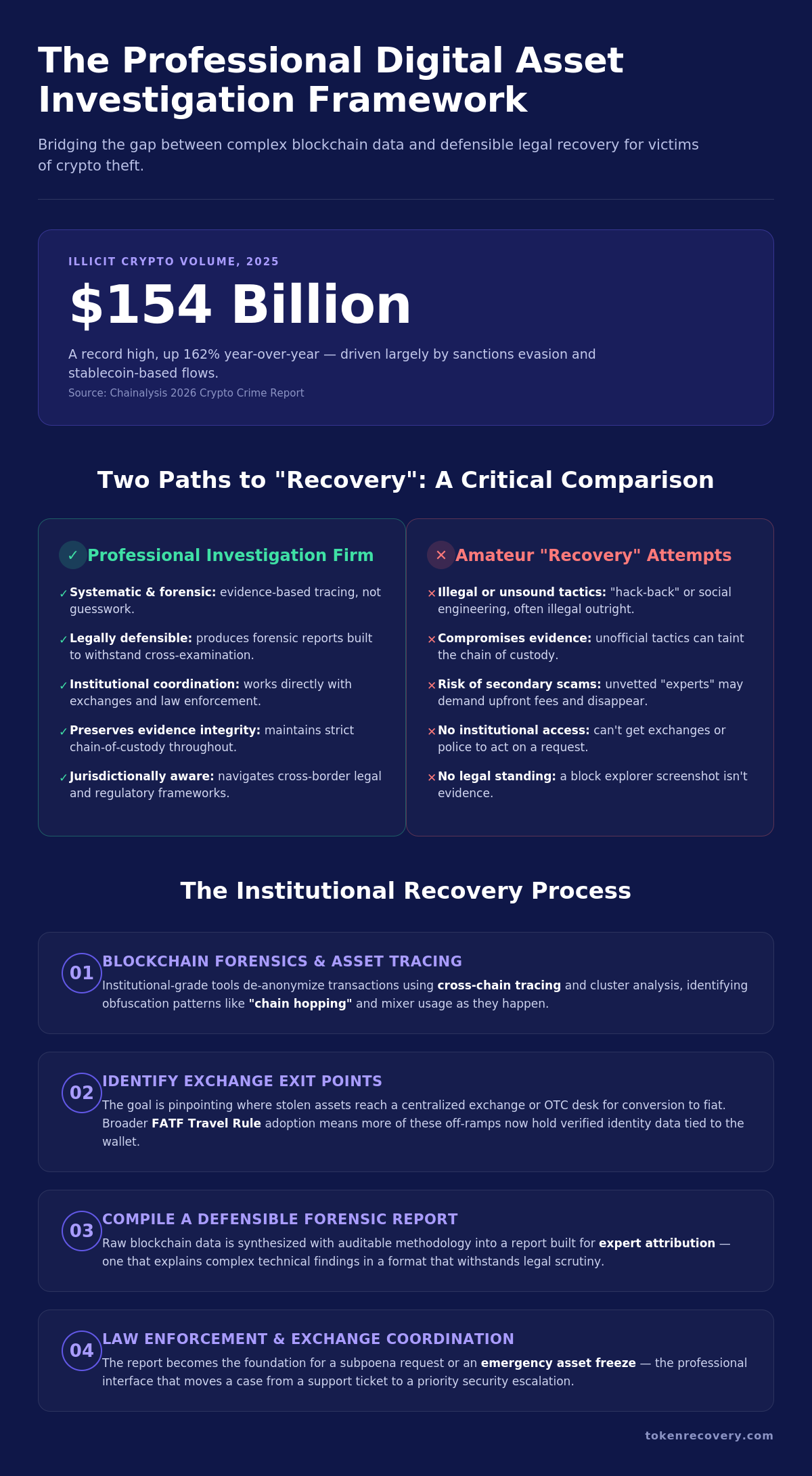
The greatest threat to a crypto theft victim often isn’t the hack itself — it’s the predatory “recovery” industry that thrives on the desperation that follows. Illicit crypto addresses received a record $154 billion in 2025, according to Chainalysis, a 162% jump driven largely by sanctions evasion and stablecoin-based laundering. As that volume grows, so does the gap between what victims can see on a block explorer and what it actually takes to get funds frozen, subpoenaed, or returned.
This article outlines the institutional frameworks that bridge blockchain data and legal recovery: how forensic tracing works, what it takes to secure assets at an exchange exit point, and how raw data becomes a defensible report that law enforcement and courts can act on.
Key Takeaways
- Amateur recovery attempts and professional investigation are not variations on a theme — they differ in evidentiary standard, legal exposure, and outcome.
- Tracing funds across chains and through obfuscation layers requires specific technical methods, not just software access.
- Freezing assets at an exchange exit point runs through formal institutional channels, not informal requests.
- A forensic report only has value if it holds up under cross-examination — that’s a different bar than “the transaction history looks suspicious.”
- Legitimate firms are evaluated on institutional history and evidentiary discipline.
Table of Contents
- Why Professional Investigation Matters
- Core Methodology: Tracing and Attribution
- From Tracing to Recovery: Exchange and Legal Coordination
- How to Evaluate a Digital Asset Investigation Firm
- The Token Recovery Approach
- FAQ
Why Professional Investigation Matters
Digital asset investigation is the systematic process of mapping blockchain transactions to real-world actors. It isn’t passive observation of a public ledger — it’s a discipline that combines technical analysis with legal strategy, because blockchains have no central authority to reverse a fraudulent transfer. The only realistic path to recovery is identifying the point where stolen funds re-enter the traditional financial system, including a VASP or converted in blacklistable assets, such as USDT, USDC, then acting fast enough and formally enough that an exchange or law enforcement agency actually responds.
That’s the part amateur “bounty hunters” get wrong. Promises to “hack back” or socially engineer a scammer are illegal in nearly every jurisdiction and compromise the very evidence a case depends on. Chain of custody matters here the same way it does in any criminal investigation: a screenshot of a block explorer isn’t evidence a prosecutor can use — a report that synthesizes transaction history with auditable methodology is.
Core Methodology: Tracing and Attribution
Blockchain forensics works by de-anonymizing data that was designed to be pseudonymous. Cross-chain tracing — following funds as they move through bridges and different networks — matters because sophisticated actors rarely leave stolen funds on a single chain; breaking the linear transaction history is the point.
One pattern investigators watch for is the “peeling chain”: funds moved rapidly through a long sequence of intermediary addresses, with a small amount peeled off at each hop. It’s worth being precise about what this actually is — a peeling chain isn’t inherently evidence of obfuscation. It’s a byproduct of the UTXO model itself, and any Bitcoin user who reuses addresses across repeated deposits can generate one without any intent to hide anything. What matters for an investigator is context: volume, timing, origin and destination pattern are what distinguish a deliberate obfuscation attempt from ordinary wallet behavior. Cluster analysis — grouping addresses by shared transaction behavior — is what lets investigators cut through this and identify the eventual off-ramp, typically a centralized exchange or OTC desk. For USDT specifically, freezing works differently — we cover the mechanics of that in our USDT freeze and recovery guide. Broader FATF Travel Rule adoption across most major jurisdictions has made these off-ramps more transparent, but it doesn’t do the tracing for you; it just means the identity data exists to request once you’ve found the right address.
Mixers raise the technical difficulty but don’t make tracing impossible. Timing and volume analysis can reconstruct the likely path through a mixer, and funds convergence, where multiple demixed threads later reconverge at the same destination, is what validates that a proposed demixing is actually highly probable rather than a coincidental match.
Privacy coins call for a different approach: by monitoring the asset pools of centralized swap services, we can infer the pass-through — i.e., which assets are being exchanged for each other — without needing to trace anything inside the privacy layer itself. We’ve covered mixer tracing in more depth in our Bitcoin mixer investigation case study.
Estate and probate cases are a distinct problem: when a digital asset holder dies without a clear inventory, an investigation firm acts as technical partner to the executor and probate court, scanning historical activity to identify balances, staked positions, or DeFi holdings tied to the decedent, and producing a Statement of Assets the court can act on. Identifying those assets is one step — actually transferring them to heirs still depends on the private key or wallet recovery method being accessible, which is a separate technical challenge the estate needs to plan for. See our crypto estate planning page for how we structure that engagement.
From Tracing to Recovery: Exchange and Legal Coordination
Tracing shows where the money went; recovery coordination is what actually gets it back. That means preparing evidentiary packages exchanges and law enforcement will act on, not just watching an address.
Exchange freeze protocols. The first 24 hours after identifying an exit point matter most. Exchanges won’t freeze an account on hearsay — they need a verified forensic map plus a formal police report from a recognized jurisdiction. Getting that package right is what moves a case from a general support ticket to a priority security escalation.
Litigation support. An exchange voluntary freeze is often temporary. Permanent recovery usually needs a court order or preliminary injunction, and that’s where forensic reports become primary evidence — and where expert witness testimony translates technical attribution into something a judge can rule on.
How to Evaluate a Digital Asset Investigation Firm
The recovery industry is largely unregulated, which makes it a target for advance-fee scams. A few concrete filters:
- No guaranteed outcome. Any firm promising a specific recovery result or success rate is a red flag, not a selling point — recovery depends on third-party cooperation nobody can guarantee in advance.
- Institutional pedigree. Look for corporate backing, named professionals, and law-enforcement or courtroom experience rather than anonymous “experts” found on social media.
- Fee transparency. Fee model alone isn’t a reliable filter — legitimate firms sometimes charge a percentage of the amount recovered, and it’s normal to pay upfront for a defined piece of work, like a forensic report, or for a validated cost genuinely required to pursue the recovery, such as court filing fees. The real red flag is different: being asked to pay an unexplained fee — a “network fee,” “tax payment,” or “release fee” — specifically to release funds that have already supposedly been recovered. Whatever the model, scope and terms should be documented before work begins.
- Technical depth. Ask how the firm handles cross-jurisdictional data requests and which L1/L2 ecosystems its team actually works in day to day.
The Token Recovery Approach
Token Recovery (Themis Recovery Switzerland AG) gives us a Switzerland-based regulatory foundation for coordinating across European and international frameworks. Our team combines blockchain forensics, recovery coordination, and litigation support, and our investigators draw on decades of law enforcement and financial-crime experience — including expert witness work in UK and international courts.
We don’t offer private key recovery, password cracking, or wallet hacking. Our work is forensic tracing and recovery coordination within a legal framework — building the evidence a prosecutor or judge can act on, not attempting to bypass wallet security ourselves.
If you’re facing a significant loss or need tracing support for an estate, schedule a consultation with our investigations team to discuss the specifics of your case.
FAQ
What’s the first thing I should do if my digital assets are stolen? It depends on the diagnosis, so this isn’t one-size-fits-all — we cover the full decision tree in our emergency response playbook. As a general rule, moving remaining assets to a reputable, regulated exchange is often safer than self-custody in the immediate aftermath: you no longer hold the private keys yourself, so there’s no risk of moving funds onto a key that’s still compromised, and the exchange has its own security controls on withdrawals. Document everything as you go — transaction hashes, timestamps, and any communication from the adversary — since a forensic investigation and, later, law enforcement will need that record for attribution.
Can a firm guarantee recovery of stolen funds? No legitimate firm can. Recovery depends on tracing, legal coordination, and third-party cooperation from exchanges — none of which any single firm controls. Anyone offering a guaranteed success rate is very likely running a secondary scam.
How long does a blockchain forensic investigation take? A preliminary trace to identify likely exit points can often be completed in under a day for straightforward cases. Compiling the full forensic report typically takes three to five business days, and a complete cross-chain investigation with international legal coordination can run several months, depending on how many obfuscation layers are involved.
What information do I need to provide to start an investigation? Transaction hashes (TXIDs), the wallet addresses involved, a detailed description of the incident, and copies of any suspicious communications or links.
Can crypto sent through a mixer still be traced? Sometimes — not all demixing is possible, and outcomes depend heavily on the mixer’s design, the volume moved, and timing. Where it is possible, timing and volume analysis plus monitoring where funds resurface downstream can de-anonymize a meaningful share of this activity.
How do law enforcement agencies use private forensic reports?
Law enforcement agencies often use private forensic reports as a valuable investigative resource to accelerate and strengthen their own investigations. Rather than replacing official police work, these reports provide a structured analysis of blockchain transactions, identify wallets, exchanges, and other key leads, and help investigators quickly understand how assets moved and where they may be recoverable. By significantly reducing the time needed to identify actionable leads, forensic reports can increase the likelihood of a successful recovery, as stolen assets are often moved or laundered rapidly.
Authorities typically verify the findings independently before relying on them in legal proceedings, but a well-prepared forensic report can expedite investigative actions, support applications for production orders or asset freezes, facilitate cross-border cooperation, and, where appropriate, serve as the basis for expert testimony in court.
Does Token Recovery do private key recovery or wallet hacking? No. We specialize in blockchain forensics, tracing, and recovery coordination within a legal framework, not unauthorized technical attempts to bypass wallet security.